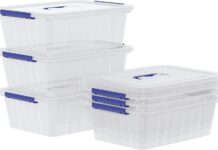
Factories in the 21st century run at blistering speeds, and their containers have to keep up. Modular grooves help interlock Industrial Plastic Bins in transit, eliminating any lateral displacement, when carried on conveyor belts with speeds of three metres a second. (For maximum airflow inside the bin, make sure the drain holes are unencumbered by placed-on foots and the collar itself.) Note: a lip to round over gives a framework gusset to ride against without losing strength. Clear windows on semi-clear polypropylene walls mean a quick visual check of stock levels without lifting the lid, a minor adjustment that saves seconds per pick and adds up to hours per week. “Tamper-evident” snaps guard pharmaceutical actives, and built-in, latch less lids pivot flush against sidewalls to prevent them from catching in automated pick-and-place arms. Even the lowly label slot has been rethought: bar codes are protected against abrasion by recessed frames, and transparent polycarbonate covers are used to keep printouts pristine in wet environments. These incremental improvements are part of what makes heavy duty Plastic Bins no longer just a commodity but rather mission-specific, data-aware workhorses.
Size and Strength: Finding Bins that Fit the Way You Work
From micro-bins carrying SMD (surface-mount device) components smaller than a grain of rice to massive 1,200-litre bulk boxes that carry textile off-cuts, the variety of dimensions of plastic containers is huge. And the right choice depends on the payload weight, material flow, and ergonomic reach envelopes. Cube/cube designer design intermediate between best cube-utilization and ideal from a human factors point of view: a 600 mm deep tote will probably provide the optimal shelf density but leave shorter operatives (those who are unable to reach the top, say 1.8 m) working on tiptoe. On the other hand, shallow bins speed up order picking by reducing dig-through time. So-called nestable designs fold down to one-third of expanded height, dramatically reducing the return-shipment volume for e-commerce companies. The weight of the bin is an issue as well, too much tare weight and the allowed pallet loads on air freight will hardly pay if the weight of the bins just to get it from point A to point B are too high and so many people like the Heavy-duty plastic bins in their high value supply lanes as they are lightweight and will not go away!
Ergonomics and Safety: Defending Your Workers & Products
Tech has brought huge advancements but who is doing what and what they are using can profoundly affect both the relation to manpower and productivity and the rate of injury. Chamfered rim edges minimize pressure on forearms when workers bring bins, and integral finger grips facilitate secure one-handed carrying of cartons less than 10 kg. Radiuses internal corners, assist with the ease of cleaning and reduce dust traps, essential in the case of food or pharmaceutical industries. The lid hinges are placed higher than the centre of mass thus preventing uncontrolled lid closure. Colour-coded handles (green for “safe lift,” red for “team lift”) give instant visual feedback, thereby saving off musculoskeletal problems. The gripping textures on the floors of the bins prevent delicate parts from sliding down ramps during transport, and enclosed hinge pins prevent the bags from coming into contact with surfaces when they are handled outside the bin and while hanging inside the bin. All these little facts serve to preach the mantra that well-designed Industrial Plastic Bins are designed to protect more than inventory—-they protect the employee.
Adding platform ladders for access to bins at various levels
Contemporary distribution centres make full use of vertical space for greater storage capacity, stacking the frames up to twelve meters high. On the fourth tier it is already dangerous to recover a container without any access equipment. Step in Platform ladders, designed to have a large standing deck, guardrails, and toe-boards that allow users to work hands free at height. Unlike a normal step-ladder, these platforms allow totes to side load, have centre lock casters to prevent float and include spring-loaded gates, which self-close behind the operator.